
On-Grid, Off-Grid, or Hybrid? A Comprehensive Guide to Choosing the Perfect Solar System in India (2025)

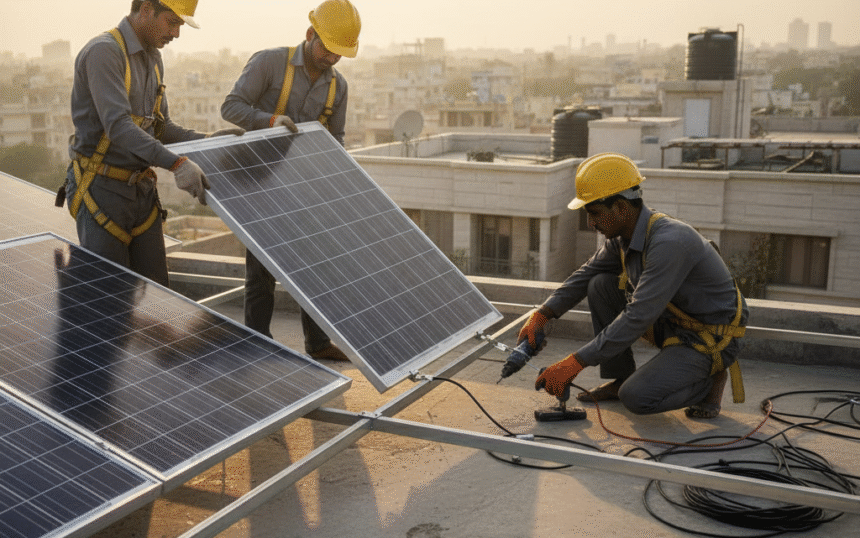
As India continues its ambitious journey toward energy independence, rooftop solar has emerged as a cornerstone of its renewable energy strategy.1 Accelerated by government incentives like the PM Surya Ghar Muft Bijli Yojana, millions of Indian homeowners are installing rooftop systems to reduce electricity bills and contribute to a sustainable future.2
However, the first and most critical decision a potential buyer faces is selecting the right type of solar system. The three primary options—On-Grid, Off-Grid, and Hybrid—serve vastly different purposes.3 An on-grid system is tied to the local utility grid, selling excess power for credits.4 An off-grid system is entirely independent, storing energy in batteries for use in remote areas.4 A hybrid system combines both, offering battery backup while remaining connected to the grid.3
Choosing the wrong system can lead to financial disappointment or a failure to meet energy security needs. This guide provides an expert-level analysis of all three systems, tailored specifically to the 2025 Indian context, comparing their operational mechanics, components, ideal user profiles, and detailed financial implications.
The Three Solar System Types Explained
Understanding how each system generates, stores, and delivers electricity is fundamental to making an informed choice.
1.1. On-Grid (Grid-Tied) Solar System
An on-grid system is the most common and simplest type of solar installation, especially in urban India.1 It operates in parallel with the local utility grid.
How It Works:
The process is straightforward:
- Generation: Solar panels capture sunlight, generating Direct Current (DC) electricity.7
- Conversion: A grid-tie inverter converts this DC power into Alternating Current (AC) power, matching the voltage and frequency of the utility grid.7
- Consumption: This AC power is used to run household appliances (lights, fans, ACs, etc.).10
- Export/Import: If the solar panels produce more power than the home is consuming, the excess power is automatically exported to the utility grid.6 At night, or when solar generation is insufficient (e.g., on a cloudy day), the home automatically draws the required power back from the grid.1
- Metering: A bi-directional “net meter” replaces the standard meter. It records both the electricity imported from the grid and the electricity exported to the grid, allowing the utility to bill for the “net” difference.9
Key Components:
- Solar Panels: Convert sunlight to DC electricity.12
- Grid-Tie Inverter: The “brain” of the system, converting DC to AC and synchronizing with the grid.9
- Bi-Directional Net Meter: Tracks the two-way flow of electricity.12
The “Power Cut Problem”:
This is the single most significant drawback of an on-grid system. During a power cut, the system will shut down completely and provide no backup power, even if the sun is shining brightly.5 This is a mandatory safety feature known as “anti-islanding.” The inverter must stop exporting power to prevent sending electricity back into downed grid lines, which could endanger utility workers performing repairs.16
1.2. Off-Grid Solar System
An off-grid system is a standalone power solution that is completely independent of the utility grid.5 It is designed for energy self-sufficiency.
How It Works:
- Generation: Solar panels generate DC electricity.19
- Charging: This DC power is fed into a Solar Charge Controller, which regulates the voltage and current to safely charge a battery bank.19
- Storage: The battery bank (typically lead-acid or lithium-ion) stores the electrical energy for later use, such as at night or on cloudy days.21
- Conversion: An off-grid inverter draws DC power from the batteries and converts it to AC power to run household appliances.19
Key Components:
- Solar Panels.20
- Solar Charge Controller: This component is essential for battery health. It prevents overcharging and deep discharging, which can damage the batteries and shorten their lifespan.19
- Battery Bank: The heart of the off-grid system. Its capacity determines how long the home can be powered without sunlight.20
- Off-Grid Inverter: Converts stored DC battery power to usable AC power.23
The “Wasted Energy Problem”:
Unlike an on-grid system, an off-grid system has no grid to export surplus power to. On a sunny day, once the battery bank is fully charged, the charge controller will stop drawing power from the solar panels to prevent overcharging.25 Any additional solar energy that could have been generated that day is lost or “wasted”.14 This makes precise system sizing crucial to balance generation with storage and consumption.
1.3. Hybrid Solar System
A hybrid system combines the key features of on-grid and off-grid systems: it is connected to the utility grid but also includes a battery bank for energy storage.3
How It Works:
The system is managed by an intelligent hybrid inverter that determines the most efficient use of power at any given moment.27 The typical priority logic is as follows:
- Self-Consumption: Power from solar panels is first used to run the home’s appliances.27
- Battery Charging: Any excess solar power is then used to charge the battery bank.28
- Grid Export: Once the batteries are fully charged, any further excess solar power is exported to the grid, earning net metering credits.27
- Nighttime Use: In the evening, the home draws power from the battery.30
- Grid Backup: Only if the batteries are depleted and solar generation is unavailable (e.g., late at night after heavy use) will the system import power from the grid.31
Key Components:
- Solar Panels.33
- Hybrid Inverter: The advanced “brain” that combines the functions of a solar inverter, battery charger, and grid-tie inverter into one device.26
- Battery Storage: Stores excess energy for backup and nighttime use.26
- Grid Connection: Allows for both importing power and exporting excess generation.26
How It Solves the “Power Cut Problem”:
This is the hybrid system’s primary advantage. When a power outage occurs, the hybrid inverter automatically disconnects from the grid (islanding) and switches to drawing power from the battery bank and solar panels, just like an off-grid system.30 This provides a seamless, uninterrupted power supply (UPS) to the home, keeping essential appliances running.31
Comparative Analysis: Pros, Cons, and Ideal User
The three systems offer distinct trade-offs in cost, independence, and financial returns. The following table provides a high-level comparison.
Table 1: At-a-Glance Solar System Comparison
| Feature | On-Grid System | Off-Grid System | Hybrid System |
| Grid Connection | Yes 14 | No 14 | Yes 14 |
| Battery Storage | No 14 | Yes, Required 14 | Yes, Optional [36] |
| Works During Power Cut | No [14, 16] | Yes 14 | Yes [14, 30] |
| Net Metering | Yes [6, 14] | No 14 | Yes 14 |
| Upfront Cost | Low 5 | High 5 | Very High 14 |
| Govt. Subsidy (PM-Surya Ghar) | Yes [1, 38] | Generally No 1 | Partial (on grid parts) [1, 39] |
| Energy Wasted | No (Exported) 14 | Yes (If battery full) 14 | No (Exported) 14 |
| Maintenance | Low 1 | High (Batteries) [41, 42] | High (Batteries) 29 |
2.1. On-Grid System: The Financial Optimizer
- Pros: This is the most economically viable option. Its upfront cost is the lowest as it does not require expensive batteries.1 It offers the highest and fastest Return on Investment (ROI), with a typical payback period in India of just 4 to 6 years.36 It qualifies for the full government subsidy 38, and its maintenance is minimal, generally limited to inverter checks and panel cleaning.1 The net metering benefit allows users to earn credits for all excess power, effectively using the grid as a free, 100% efficient “battery”.4
- Cons: The system’s complete dependency on the grid means it offers zero power backup during an outage.5
- Ideal User Profile: The cost-conscious homeowner in an urban metro or Tier-1 city (e.g., Mumbai, Delhi, Bangalore, Pune) with a stable and reliable electricity grid.1 Their primary objective is to minimize electricity bills and achieve the best possible financial return on their investment.1
2.2. Off-Grid System: The Independence Seeker
- Pros: This system offers complete energy independence and is a lifeline for locations without grid access.4 It provides reliable, 24/7 power (when sized correctly) and is immune to grid failures, blackouts, and price hikes.14
- Cons: This is the most expensive system due to the necessity of a large battery bank.5 These batteries require significant maintenance (especially lead-acid types) and have a limited lifespan (5-15 years), necessitating costly replacement.14 The system is not eligible for net metering and can waste surplus solar energy when batteries are full.14
- Ideal User Profile: Homeowners in remote or rural areas of India, such as farms, mountainous regions, or eco-resorts, where the utility grid is non-existent or so unreliable that it is effectively unusable.15 For this user, the high cost is a necessity for accessing electricity at all.
2.3. Hybrid System: The Resilience Builder
- Pros: This system provides the ultimate “all-in-one” solution: energy security and financial savings. It offers seamless, automatic backup power during outages, just like an off-grid system.1 It also optimizes self-consumption by storing free solar energy for use at night.30 Crucially, it remains eligible for net metering, allowing it to earn credits for any surplus power once the batteries are full.14
- Cons: This is the most expensive option, often costing 50-100% more than an on-grid system due to the high price of both the battery bank and the advanced hybrid inverter.1 It is also more complex to install and shares the same long-term battery replacement costs as an off-grid system.1
- Ideal User Profile: The homeowner who values energy security and peace of mind above all else. This user typically lives in an area with an unreliable grid—such as a Tier-2 city, a suburb, or a region (like Chennai or Hyderabad) prone to frequent load-shedding and long outages.15 They are willing to pay a significant premium to ensure their home remains powered 24/7, while still enjoying the benefit of reduced monthly bills.35
Financial Analysis: Cost, Subsidy, and ROI (2025 India Focus)
The financial case for each system varies dramatically. As of 2025, costs in India are influenced by system size, brand, panel technology (e.g., monocrystalline, polycrystalline), and, most importantly, the inclusion of batteries.52
3.1. Upfront Installation Costs (2025 Data)
The following tables provide approximate 2025 installation costs for common residential system sizes in India. These prices are indicative and can vary by city and vendor.
Table 2: 3kW System Cost Comparison (India 2025)
| 3kW System Type | Approximate Price Range (INR) | Battery Included? |
| On-Grid | ₹1,50,000 – ₹1,80,000 [54, 55] | No |
| Off-Grid | ₹2,40,000 – ₹2,80,000 [54, 55] | Yes |
| Hybrid | ₹2,70,000 – ₹3,00,000 [54, 55] (up to ₹4,50,000) [56] | Yes |
Table 3: 5kW System Cost Comparison (India 2025)
| 5kW System Type | Approximate Price Range (INR) | Battery Included? |
| On-Grid | ₹2,60,000 – ₹3,00,000 [57] | No |
| Off-Grid | ₹3,50,000 – ₹4,20,000 [57] (up to ₹5,00,000) [58] | Yes |
| Hybrid | ₹4,00,000 – ₹4,70,000 [57] (up to ₹7,50,000) [52] | Yes |
The data clearly shows that the inclusion of batteries in off-grid and hybrid systems is the primary cost driver.29 A 5kW hybrid system can easily cost almost double its 5kW on-grid counterpart 52, a premium paid entirely for energy storage and backup capability.41
3.2. Government Subsidies: The PM Surya Ghar Muft Bijli Yojana
The “PM Surya Ghar Muft Bijli Yojana” scheme, launched in 2024, is the primary driver of residential solar adoption in 2025.2
Subsidy Structure:
The Central Financial Assistance (CFA) for residential households is structured as follows 2:
- 1-2 kW Systems: ₹30,000 per kW
- 3 kW Systems: ₹30,000 for the first 2 kW + ₹18,000 for the 3rd kW (Total: ₹78,000)
- Above 3 kW Systems: The subsidy is capped at a maximum of ₹78,000.2
Policy Nuance: Subsidy Eligibility
This policy creates a critical financial distinction between the systems:
- On-Grid Systems: These are the primary target of the scheme. As grid-connected systems, they are fully eligible for the CFA described above.61
- Off-Grid Systems: Standalone off-grid systems are generally not eligible for subsidies under this residential rooftop program.1
- Hybrid Systems: This is a crucial nuance. Recent MNRE clarifications confirm that hybrid inverters are permitted under the PM Surya Ghar scheme.39 However, the subsidy is calculated only for the grid-connected components (the solar panels and inverter), not for the battery storage component.1 Therefore, while a hybrid system can receive the maximum ₹78,000 subsidy, this subsidy covers a much smaller percentage of its total (and much higher) cost.
3.3. Return on Investment (ROI) and Payback Period
Payback period represents the time it takes to recover the initial investment through electricity savings, while ROI represents the total lifetime profitability of the system.64
- On-Grid ROI: This system offers the best and fastest financial returns.65 With low upfront costs and high savings from net metering, the payback period in India is typically a short 4 to 6 years.36 Given a 25-year lifespan for solar panels, this provides ~20 years of virtually free electricity.66
- Hybrid & Off-Grid ROI: The payback period is significantly longer, often 6 to 10 years or more.41 The primary reason, aside from the higher initial cost, is the long-term replacement cost of batteries. A battery bank will likely need to be replaced every 5-15 years, depending on the technology (e.g., lead-acid: 5-7 years; lithium-ion: 10-15 years).68 This recurring capital expense drastically reduces the system’s lifetime ROI.29 One estimate suggests a 5kW on-grid system may pay for itself in ~3.8 years, whereas the same system with a battery (hybrid) could take 10 to 17 years to break even.43
Key Scenarios and Recommendations
The optimal choice depends entirely on the user’s location and priorities.
4.1. Scenario 1: The Urban Homeowner (Stable Grid)
- Profile: Lives in a metro or Tier-1 city (e.g., Bangalore, Mumbai, Delhi) with a stable grid connection where power cuts are rare and brief.1
- Recommendation: On-Grid System.
- Rationale: This user’s primary goal is financial savings.1 The on-grid system provides the lowest installation cost, qualifies for the full government subsidy, and offers the fastest payback (4-6 years).46 Paying the significant premium for a hybrid system’s battery is “overkill” and an inefficient use of capital when the grid is already reliable.1
- Alternative Consideration: Some users explore installing a subsidized on-grid system alongside their existing, separate UPS/inverter battery. This is a cheaper setup than a true hybrid system.73 However, it is less effective; during a power cut, the on-grid solar system will still shut down (due to anti-islanding), and the standard inverter cannot be recharged by the solar panels. It only provides backup until its own battery dies. A true hybrid system can recharge its batteries from the sun during a power cut, offering much greater resilience.73
4.2. Scenario 2: The Suburban/Tier-2 Homeowner (Unreliable Grid)
- Profile: Lives in an area with an unstable grid, experiencing frequent, long, or unpredictable power cuts (i.e., load-shedding).15
- Recommendation: Hybrid System.
- Rationale: This system is perfectly designed for this user. It directly solves their primary “pain point”—energy insecurity—by providing seamless, automatic backup power.35 It essentially functions as a silent, solar-rechargeable generator or a high-capacity UPS.34 The high premium is justified by the invaluable, practical benefit of 24/7, uninterrupted power and peace of mind.50 Furthermore, it still reduces monthly electricity bills through solar self-consumption and net metering when the grid is active.37
4.3. Scenario 3: The Remote/Rural Property (No Grid Access)
- Profile: A farmhouse, a home in a remote village, or an off-grid commercial property (like an eco-resort) with no physical connection to the utility grid.41
- Recommendation: Off-Grid System.
- Rationale: For this user, the decision is not based on ROI but on necessity. An off-grid system is the only solution for achieving energy independence and accessing reliable electricity.4 The high cost of the battery bank is a mandatory investment to ensure power is available at night and during periods of low sunlight.19
Conclusion: The Final Decision-Making Matrix
In 2025, the choice between on-grid, off-grid, and hybrid solar systems in India is not a question of which is technologically superior, but which is functionally appropriate for the user’s specific needs. The decision is a direct trade-off between financial return and energy resilience.
An on-grid system is a pure financial investment, optimized for maximum savings in areas with a reliable grid. An off-grid system is a capital-intensive solution for a fundamental need: providing power where none exists. The hybrid system occupies the critical middle ground, serving as a premium resilience tool for those who need to weather an unreliable grid while still benefiting from it when it is active.
Table 4: Final Decision-Making Matrix
| If Your Grid Is… | And Your Main Goal Is… | Your Perfect System Is… |
| Reliable (e.g., Urban Metro) | Maximum Financial ROI / Bill Reduction | On-Grid [44, 45] |
| Unreliable (e.g., Frequent, Long Cuts) | Backup Security + Bill Reduction | Hybrid [15, 29, 35] |
| Non-Existent (e.g., Remote/Rural) | Energy Independence (Basic Access) | Off-Grid 41 |