The AIoT Revolution in Solar: An Expert Analysis of Smart Technology and Generation Optimization

The solar power industry is undergoing a profound transformation, evolving from a passive generator of intermittent energy to a fully autonomous, predictive, and dispatchable digital asset. This shift is being engineered by the convergence of two core technologies: the Internet of Things (IoT) and Artificial Intelligence (AI). This combination, increasingly referred to as AIoT , is no longer a future-facing concept but a commercial-scale reality in 2025, fundamentally re-engineering the financial and operational models of solar generation.
This report provides an expert analysis of how this AIoT framework functions, detailing the optimization verticals that are creating tangible value across the solar value chain. These verticals include:
- Predictive Maintenance (O&M): Moving from a reactive or preventive cost model to a predictive, data-driven model that maximizes uptime and asset lifespan.
- Autonomous Operations: Deploying AI-driven robotics and systems that execute O&M tasks, such as soiling removal, with optimized, data-driven efficiency.
- Generation Forecasting: Utilizing AI to provide high-precision generation forecasts, a “mission-critical” function for financial survival in markets with high grid-deviation penalties.
- Grid Integration: Using AI to orchestrate distributed assets, including batteries and electric vehicles, to create Virtual Power Plants (VPPs) that provide stability and flexibility to the grid.
This technological adoption is not uniform; it is being accelerated by financial necessity. Fast-growing energy markets, particularly India, serve as a primary case study. In these high-stakes environments, where severe financial penalties are levied for grid deviation , AI-driven forecasting and management are not merely an upgrade but an essential tool for survival and profitability. The key finding of this analysis is that AIoT is successfully transforming solar Operations & Maintenance (O&M) from a reactive cost center into a proactive, high-return function of revenue and yield optimization.
Part 1: The AIoT Framework: Sensing, Analyzing, and Acting
The optimization of solar power is built on a symbiotic technological relationship. The Internet of Things (IoT) provides the digital “nervous system,” a vast network of sensors that collect and transmit high-velocity, granular data. Artificial Intelligence (AI) provides the “brain,” using sophisticated algorithms to analyze that data, identify patterns, make predictions, and automate intelligent actions. Without the IoT data layer, AI is blind; without the AI analytics layer, the data is just noise.
1.1 The Nervous System (IoT): Establishing the High-Fidelity Data Layer
The value of any AI-driven optimization is directly proportional to the quality, granularity, and real-time nature of the data it receives. A robust, multi-layered IoT sensory network is the foundation of the modern “smart” solar asset.
- Smart Inverters: The solar inverter has evolved far beyond its original function of converting DC power to AC. Today’s smart inverters are sophisticated, IoT-enabled data hubs and primary control points for the entire solar asset. Functioning as a “smart assistant” for the system , they provide two-way communication, enabling remote monitoring and control of energy production via mobile apps or web interfaces. By integrating AI and IoT connectivity, the smart inverter continuously monitors and analyzes energy consumption patterns to optimize generation in real-time.
- Panel-Level and Environmental Sensors: IoT sensors are mounted directly on or near solar panels to gather real-time data on both performance and surrounding environmental factors. This includes monitoring the voltage output pin of the solar panel, the panel’s temperature (often using sensors like the LM-35), and the precise intensity of incident light (using LDR sensors).
- Environmental & Locational Sensors (The “Digital Twin” Inputs): To build an accurate performance model, the system must know the “ground truth” of its available fuel—sunlight.
- Irradiance Sensors (Pyranometers): These sensors are critical for establishing the baseline of available solar energy. A pyranometer measures solar irradiance on a flat surface, capturing radiation in watts per square meter (). This data, measuring both direct and diffuse components of sunlight , is the pivotal metric used to calculate a plant’s “expected” generation. This benchmarking is essential for climatological models and performance validation.
- Soiling Sensors: In large-scale solar farms, performance is significantly degraded by the accumulation of dust, pollen, and grime—a phenomenon known as “soiling”. Specialized soiling sensors are used to measure the precise impact of this accumulation. These systems, which must comply with standards like IEC 61724-1 for Class A plants, work by using optical or infrared light to measure the reduction in light reaching the panel surface. Some models compare the output of a soiled reference cell to an identical cell that is automatically cleaned daily, providing a “soiling-loss index” that quantifies the exact percentage of power loss.
- Data Aggregation and Transmission: This continuous stream of data from inverters and sensors is aggregated by on-site IoT gateways and securely transmitted to cloud-based platforms. This cloud infrastructure provides the scalable computing power needed to store and analyze the vast amounts of data , enabling operators to remotely monitor and manage assets from anywhere in the world. This effectively creates a real-time, high-resolution “digital twin” of the physical solar farm.
1.2 The Brain (AI): Transforming Data into Monetary Value
The terabytes of data collected by the IoT nervous system are processed by AI—specifically machine learning (ML) and deep learning algorithms—to unlock financial and operational value.
- Machine Learning Models: The primary AI models used in solar optimization include:
- Supervised Learning: These models are trained on vast historical datasets with known outcomes. For example, an algorithm can be fed thousands of instances of “inverter performance data” (voltage, temperature, current) and the “known outcome” (e.g., “inverter failed 3 days later”). The model “learns” to identify the subtle data patterns that precede a failure, enabling it to predict future failures.
- Unsupervised Learning: These models are designed to analyze real-time data and find anomalies or hidden patterns without prior training on known outcomes. This is highly effective for fault detection. For instance, the AI can compare the output of thousands of panels in real-time, flagging one that is underperforming by 5% compared to its neighbors, even when all environmental factors (irradiance, temperature, soiling) are identical.
- Deep Learning (Neural Networks): These more complex models are used for non-linear, complex problems. In solar, this is most prominent in generation forecasting, where deep learning models analyze intricate patterns in satellite imagery to predict cloud movement and density , or in using convolutional neural networks (CNNs) to classify different types of soiling or panel defects (like micro-cracks) from drone or robotic images.
- The AIoT Optimization Flywheel: This framework creates a continuous, self-improving loop. The IoT sensors collect data. The AI analyzes this data and generates a predictive insight (e.g., “Inverter #47 will fail in 72 hours,” or “Soiling levels on Array B-12 are causing an 8% production loss”). This insight is then fed back into the system, automatically triggering an action through its IoT connectivity—such as issuing a remote alert, creating a prioritized maintenance ticket, or dispatching an autonomous cleaning robot to Array B-12.
This AIoT framework fundamentally re-engineers the financial model of a solar plant. Previously, an asset manager might see that a plant underperformed its Energy Yield Assessment (EYA) for the month but would struggle to determine why. Was it due to poor weather, a degrading panel, an inverter clipping, or a layer of invisible dust? The new AIoT system, powered by this fusion of granular sensing and intelligent analysis, can now provide a precise “Loss Factor Analysis”. It can disaggregate the loss, for example: “The plant lost 2.5 MW of potential generation yesterday. AI analysis attributes 1.0 MW to soiling losses, 0.8 MW to inverter clipping during peak irradiance, and 0.7 MW to unanticipated cloud cover.”
This capability shifts O&M from a reactive engineering function to a proactive financial asset management function. The operator can now make data-driven financial decisions in real-time: “Is the $50,000 cost of deploying a robotic cleaning cycle today worth the $70,000 in revenue we will recapture from that 1.0 MW of soiling loss? Yes. Deploy the robots.”
Furthermore, at the residential and commercial scale, the AI-powered smart inverter is emerging as the “keystone component” for the entire distributed smart grid. By managing the flow of energy and data between the panels, the battery, the electric vehicle, and the grid , the smart inverter is the central gateway. This positions the inverter manufacturer as the dominant player in the “smart home” energy ecosystem. The company that controls the inverter controls the data and energy flow, making it the most valuable partner for grid operators looking to aggregate these distributed assets into VPPs and V2G networks.
Part 2: AI-Driven Optimization: From Proactive Maintenance to Autonomous Operations
The most immediate and commercially mature application of AIoT in the solar industry is in Operations & Maintenance (O&M). This technology is catalyzing a complete paradigm shift, moving O&M from a reactive, labor-intensive cost center to a predictive, autonomous, and data-driven function that actively maximizes revenue.
2.1 Predictive Maintenance: Eliminating Downtime
- The Old Paradigms (Reactive vs. Preventive): Traditionally, solar O&M has fallen into two categories. Reactive maintenance is the “fix-it-when-it-breaks” model, where a component failure (like an inverter) causes a sudden, costly outage, and technicians are dispatched to diagnose and repair the issue. Preventive maintenance is a more structured approach, relying on scheduled checkups and replacements (e.g., “inspect all inverters every 6 months”). While better than being reactive, this model is highly inefficient, leading to unnecessary manual inspections, replacing components that are not faulty, and still failing to prevent all breakdowns.
- The New Paradigm (Predictive): AI-driven predictive maintenance uses the continuous stream of data from IoT sensors to forecast when a component is likely to fail, before it fails. By analyzing subtle changes in operational data, AI algorithms can predict equipment failure by identifying patterns that a human operator would miss. This allows operators to schedule maintenance interventions precisely when needed, before the failure and resulting downtime occurs. This proactive approach has been shown to reduce maintenance costs by up to 40% and significantly extend the lifespan of the solar system.
- Specific Applications:
- AI-Based Fault and Anomaly Detection: AI algorithms continuously analyze performance trends, such as voltage, current, and temperature, to detect inefficiencies and anomalies. These systems can identify and even classify complex fault signatures, such as partial shading combined with degraded modules, dust accumulation, or short-circuited diodes.
- In-Depth: Predicting Critical Component Failure (Inverters): Inverters are one of the most common and critical points of failure in a solar system. AI models, particularly supervised learning algorithms, are trained on historical datasets of inverter failures. They learn to recognize the subtle electrical or thermal “signatures” (e.g., small voltage changes, gradual temperature creep) that indicate an impending failure. The AI system then flags the specific component, ranks the alert by urgency, and allows the operator to schedule a proactive repair, minimizing downtime and streamlining maintenance logistics.
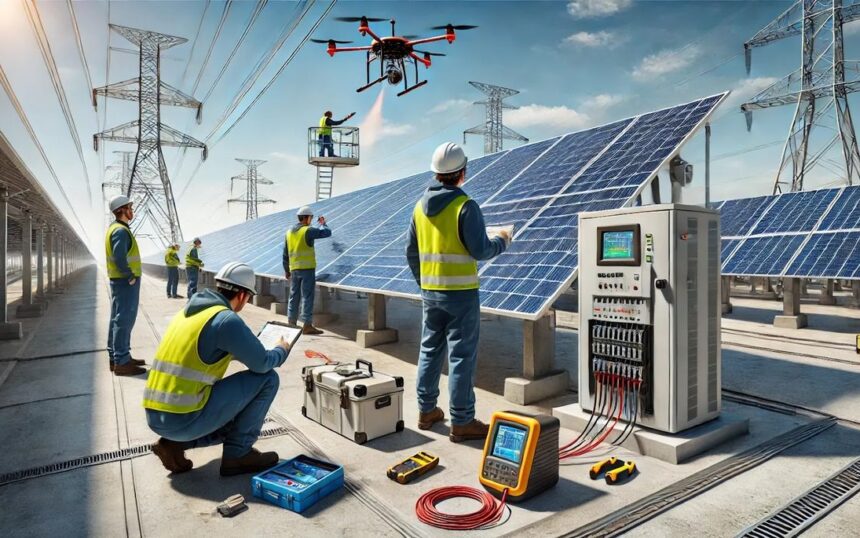
- Aerial Thermography (Drones + AI): For large, utility-scale solar farms, manual inspection is impractical. The AIoT solution involves autonomous drones equipped with high-resolution thermal imaging cameras. The drone flies a pre-programmed path, capturing thermal and visual images of thousands of panels. These images are then fed into an AI platform that uses computer vision and machine learning to analyze them. The AI can instantly identify “hotspots” (indicating faulty cells), micro-cracks, dirt accumulation, or underperforming panels, far faster and more accurately than any human inspection team.
2.2 Analyst Insight: “Loss Factor Analysis” – The New KPI for Asset Management
Predictive maintenance has evolved beyond simple fault detection (“this inverter is broken”). Advanced AI platforms, as of 2025, are now providing what is termed “Loss Factor Analysis”.
This is a far more granular and financially-focused application of AI. The platform uses the complete IoT data (irradiance, soiling, temperature, inverter data) to build a “digital twin” of the plant and calculate its theoretical maximum output for any given moment. It then compares this to the actual output and, most critically, uses AI to break down the sources of any performance gap.
This analysis disaggregates all energy losses—such as those from soiling (dust), mismatch (panels degrading at different rates), downtime, and clipping (inverter unable to handle all available DC power)—against the theoretical baseline.
The operational and financial implications are enormous. An asset manager is no longer looking at a single, aggregated “underperformance” number. Instead, they receive a detailed diagnostic report: “Plant-wide losses are at 6%. This is comprised of 3.5% from soiling, 1.5% from inverter clipping, and 1.0% from component mismatch.” This “Loss Factor Analysis” reveals exactly where and why losses are occurring, allowing O&M teams to prioritize corrective actions based on which intervention will recapture the most revenue.
2.3 Autonomous Operations: AI-Powered Robotics
The next logical step in this evolution is to move from predicting a problem to autonomously fixing it. The primary and most commercially advanced application of this is AI-powered robotic cleaning.
- The Problem: Soiling: In many of the world’s sunniest regions—such as Rajasthan, India, or the Middle East—dust is a severe operational challenge. Soiling can significantly reduce energy output, and traditional cleaning methods are problematic: they are manual, labor-intensive, and inconsistent. Worse, they are incredibly water-intensive, consuming an estimated 7,000 to 10,000 liters of water per MW per cleaning cycle —a critical issue in the very arid regions where solar farms are most viable.
- The AIoT Solution: Smart Robotics:
- Sensing: IoT soiling sensors (as detailed in Part 1.1) provide real-time, quantitative data on dust accumulation.
- Analysis: The plant’s central AI platform analyzes this soiling data. Instead of relying on a fixed schedule (e.g., “clean every Tuesday”), the AI optimizes the schedule based on data. It calculates the precise financial tipping point where the cost of the production loss from soiling becomes greater than the cost of deploying the robots. This model might also integrate weather forecasts, delaying a cleaning cycle if rain is predicted tomorrow.
- Action: Once the AI determines a cleaning is financially optimal (e.g., when efficiency loss crosses a 3-5% threshold), it autonomously dispatches a fleet of robotic cleaners.
- Technology in Action: These robotic systems are often “waterless,” using a combination of microfiber rollers, soft brushes, or air jets to remove dust. Many are self-powered, recharging from small, onboard solar panels, and navigate the panel arrays autonomously using wheels, tracks, or rail systems.
- Case Study: Bhadla Solar Park & SolaRob: This technology is already heavily deployed. At Bhadla Solar Park in Rajasthan, India—one of the world’s largest solar parks—dust accumulation is a massive operational challenge. To mitigate this, the park has adopted ground-based robotic cleaning systems. Indian companies like SolaRob (a division of Axel Robotics) have engineered solutions specifically for this market, offering the “SolaRob Aero” (a zero-water, dry-cleaning system for desert climates) and the “SolaRob AquaX” (a hybrid wet/dry system for high-pollution zones).
- Quantifiable Impact: The results of this autonomous approach are striking. Solar farms adopting these systems have reported an 8% to 15% increase in annual energy generation. In one example, a 50 MW solar farm in Rajasthan saw a 12% efficiency gain, translating to an ₹8 crore (approx. $960,000 USD) annual revenue boost. For utility-scale farms, this data-driven robotic O&M is a necessity for financial sustainability, with companies reporting a full Return on Investment (ROI) in as little as 12 months in high-dust zones.
Table 1: The O&M Evolution: From Reactive to Autonomous
| Maintenance Model | Methodology | Key Technology | Primary Metric | Commercial Impact |
| Reactive | Fix component upon failure. | Human labor, Spare parts. | Downtime (Hours/Days). | High downtime, high revenue loss, unpredictable costs. |
| Preventive | Time-based inspection and replacement schedule. | Spreadsheets, Manual labor. | Schedule Adherence. | High labor costs, inefficient resource use, moderate downtime. |
| Predictive | AI-driven data analysis forecasts component failure. | AI algorithms, IoT sensors, Drones, Cloud platforms.[31, 33] | Failure Prediction Accuracy. | Reduced costs (up to 40%) , maximized uptime, lower repair cost. |
| Autonomous | AI analysis + automated robotic action. | AIoT, Soiling Sensors, Cleaning Robots. | Yield Optimized (kWh) / Loss Minimized (%). | Maximized revenue (8-15% gain) , minimized water/labor cost, rapid ROI. |
Part 3: Forecasting and Grid Integration: The Macro-Optimization
While AIoT optimizes the performance of the individual asset, its most transformative impact lies in managing the asset’s relationship with the wider energy ecosystem. AI’s predictive power is what allows intermittent solar energy to be safely and profitably integrated into the grid at scale, turning a variable source into a predictable, dispatchable, and stable component of the energy mix.
3.1 Mission-Critical Forecasting: Stabilizing an Intermittent Grid
- The Core Challenge: The primary challenge of solar power is its intermittency. Grid operators are responsible for balancing electricity supply and demand perfectly, every second of every day. In the past, when renewables were a small fraction of the energy mix, their variability could be easily absorbed. However, as solar and wind rapidly scale to 20% or 30% of total capacity, their inherent variability—a sudden drop in generation from a passing cloud bank—becomes a significant threat to grid stability.
- The AI Solution: Precision Forecasting: Artificial intelligence is now the gold standard for energy forecasting, vastly outperforming traditional physics-based models.
- How it Works: AI models, particularly deep learning neural networks, are trained to find complex, non-linear patterns by ingesting massive, diverse datasets. These inputs include:
- Meteorological Data: Real-time ground station data on temperature, humidity, wind speed, and barometric pressure.
- Satellite Imagery: Real-time satellite feeds that AI analyzes to track cloud movement, thickness, and atmospheric conditions.
- Sky Cameras: On-site, ground-based cameras that provide hyper-local, “now-casting” data on cloud formations, enhancing the precision of short-term (minute-to-minute) predictions.
- Historical Performance Data: The solar plant’s own generation history, which the AI uses to learn the asset’s specific performance characteristics.
- This hybrid, data-driven approach allows AI to predict not just if a cloud will block the sun, but how the cloud will move and how much sunlight will be blocked, down to specific solar installations.
- How it Works: AI models, particularly deep learning neural networks, are trained to find complex, non-linear patterns by ingesting massive, diverse datasets. These inputs include:
- Case Study: The 2025 Indian Energy Market (A High-Stakes Proving Ground): The critical importance of this technology is most evident in markets with severe financial penalties for inaccuracy. The Indian energy market provides a clear example of this trend.
- The Financial Driver: In India, renewable energy generators are subject to a strict scheduling regime. They must “lock in” their generation forecasts well in advance. If they deviate from this forecast—by either over-producing or under-producing—they are subject to severe “financial penalties,” known as deviation charges.
- The 2026 Cliff: This financial risk is escalating. These penalties are already high and are set to increase significantly from April 2026, as the allowed margin of error for renewable generators is scheduled to “shrink sharply”.
- This regulatory framework makes AI-driven forecasting a tool of financial survival. A missed weather forecast is not just an operational error; it is a “millions of dollars lost in a single day” event. This punitive market structure, in contrast to more flexible pooling models in Europe, forces developers to bear the full cost of forecast errors.
- The AI Edge: This high-stakes environment is accelerating AI adoption in India. AI models that can “capture micro-trends that traditional models often miss” and provide “short-term (intra-day) updates” are a direct financial hedge against these penalties. This allows generators to continually refine their schedules and minimize their financial exposure.
3.2 The Smart Asset: AI-Optimized Battery Storage and Residential Systems
AI’s predictive power is also being deployed at the residential and commercial level, particularly in systems that pair solar panels with a Battery Energy Storage System (BESS).
- AI-Driven Battery Management: The AI, often running within the smart inverter, acts as an intelligent energy manager for the home or business. It optimizes battery performance in several ways:
- Intelligent Charging/Discharging: By integrating the AI-driven weather forecast, the system “knows” if cloudy weather is approaching. It will then automatically prioritize using abundant sunshine now to fully charge the battery, ensuring energy is stored before production drops.
- Peak Shaving and Load Management: The AI learns the household’s unique energy consumption patterns. It also monitors the grid, including real-time electricity rates. It can then automatically “peak shave” by discharging the battery to power the home during expensive “peak” demand hours (e.g., 5-9 PM) and recharging the battery from cheap “off-peak” grid power or free solar power during the day.
- Extending Battery Life: This intelligent management—preventing unnecessary charge/discharge cycles and maintaining optimal charge levels—dramatically reduces battery degradation. This can extend the expensive battery’s operational lifespan by up to 40%.
- Quantifiable Homeowner Benefits: This AI-driven optimization, enabled by the smart inverter, provides tangible and significant savings. Reports from 2025 indicate that users with these systems can achieve up to 30% in annual energy savings and see their electricity bills cut by as much as 40%.
3.3 The Future of the Grid: Virtual Power Plants (VPPs) and V2G
The ultimate macro-optimization is to use AI to aggregate thousands of these individual “smart assets” (homes, businesses, EV chargers) and orchestrate them to act as a single, large power plant.
- Virtual Power Plants (VPPs): A VPP is a cloud-based digital platform that uses AI and IoT to centrally control a “virtual” fleet of Distributed Energy Resources (DERs), which can include rooftop solar, BESS, and even smart appliances. The AI acts as the “orchestrator,” analyzing grid conditions (like frequency and demand) and dispatching its network of small-scale assets in real-time to provide grid-stabilizing services, such as frequency regulation or peak shaving, just as a large, conventional power plant would.
- India 2025 Case Study: The Delhi BSES VPP Pilot: India is actively piloting this technology. A landmark project is being run by BSES Rajdhani Power Limited (BRPL), a joint venture between Reliance Infrastructure and the Delhi government.
- In May 2025, this project launched India’s first utility-scale, standalone Battery Energy Storage System (BESS) project (20 MW) in Kilokri, Delhi, in collaboration with IndiGrid and the Global Energy Alliance for People and Planet (GEAPP).
- Crucially, this BESS is part of a larger VPP architecture. A central Energy Management System (AHE’s ELINA-Server) installed in the BSES SCADA (Supervisory Control and Data Acquisition) center centrally controls multiple distributed BESS sites, creating “the first of its kind Virtual Power Plant (VPP) in the country”. This VPP can perform energy shifting and peak shaving to support the grid and improve reliability for over 100,000 residents.
- Vehicle-to-Grid (V2G) Technology: This is the next frontier, treating the batteries inside electric vehicles (EVs) as a mobile, distributed energy resource. V2G technology, when paired with a bi-directional charger, allows an EV not just to draw power from the grid, but to send power back to the grid when it is parked.
- India 2025 Case Study: The Kerala V2G Pilot: In July 2025, the Kerala State Electricity Board (KSEB) and the Indian Institute of Technology Bombay (IIT Bombay) signed an MoU to launch India’s first large-scale V2G field trial.
- This pilot reframes the entire narrative around EVs and renewables. The project’s stated aim is not just to test V2G, but explicitly to “stabilize the grid and help in addressing various technical issues (over voltage, unbalanced loading etc.) due to rapidly increasing rooftop PV in the State”.
- This is a sophisticated, systemic solution. Unmanaged rooftop solar floods the local grid with power during sunny afternoons when demand is low, causing voltage and stability problems. The KSEB/IIT Bombay pilot is testing the hypothesis that a fleet of V2G-enabled EVs, orchestrated by an AI-powered VPP, can be used as a “mobile sponge.” The EVs can be programmed to absorb this excess, free solar power during the day, and then discharge it back to the grid during the high-demand evening peak.
- This model transforms EVs from a potential “problem” (a massive new load on the grid) into a core “solution.” The AI-orchestrated V2G fleet becomes a massive, distributed battery that solves the solar intermittency problem, increasing the grid’s capacity to host more renewable energy.
Part 4: Enterprise-Level Digital Transformation: Utility-Scale Case Studies (India)
This systemic integration of AIoT is moving from pilot programs to become the core business strategy for India’s largest renewable energy corporations. These companies are building centralized, AI-driven “command and control” platforms to manage their vast, continent-spanning portfolios, proving the enterprise-scale value of this digital transformation.
4.1 The Centralized Command Center: Adani’s ENOC
Adani Green Energy (AGEL), one of the world’s largest solar developers, manages its massive portfolio—which includes the 780 MW Kamuthi Solar Plant in Tamil Nadu —from a central “Energy Network Operations Centre” (ENOC).
This ENOC functions as the “brain” of their entire operation. It is not a passive monitoring center but an active, AI-driven O&M hub. The platform uses “Analytics driven O&M with AI based technology” to move beyond simple monitoring to “prescriptive analytics”.
- Descriptive Analytics asks “What happened?”
- Predictive Analytics asks “What will happen?”
- Prescriptive Analytics asks “What should we do?”
AGEL’s ENOC platform uses AI and machine learning for pattern recognition to identify underperformance signatures across all its sites, such as inter-row shading or dust accumulation. This centralized AI approach allows them to “maximize generation and perform predictive maintenance” across their entire national portfolio from a single location.
4.2 Digital Twins and AI Platforms: Tata Power and ReNew
This enterprise-level digital strategy is mirrored by other major players in the Indian market.
- Tata Power: Tata Power, a leading solar manufacturer and developer in India , is explicitly focused on closing the “data-to-action gap” by “trading static spreadsheets for digital twins and AI-driven dispatch”.
- Their “digital twin” platform integrates GIS mapping, satellite imagery for site selection, and hyper-local weather forecasts. This allows them to “surface design flaws long before construction” and, for operational assets, to “squeeze maximum output into tight trading windows” (a clear reference to managing the deviation penalty risk).
- At the Distributech 2025 conference, Tata Power and TCS (Tata Consultancy Services) unveiled “EnerUni,” a new integrated energy management platform co-created to harness digital solutions and AI-enabled optimizations to manage the “unprecedented stress” on the modern grid.
- ReNew Power: ReNew, another of India’s largest renewable companies with an 18.5 GW portfolio , directly quantifies the financial impact of its AI strategy.
- The company states that “leveraging AI has not only improved our electricity output by up to 1.5% from existing solar and wind installations but also streamlined maintenance”.
- A 1.5% output increase may sound modest, but for a multi-gigawatt portfolio, this gain is enormous. For ReNew’s 18.5 GW portfolio, a 1.5% increase represents 277.5 MW of “new” capacity. This is the generation equivalent of a whole new power plant, achieved with zero new land, zero new panels, and zero new steel. It is a purely data-driven, high-margin capacity increase, demonstrating the direct translation of AI analytics into monetary value.
- Like its competitors, ReNew uses AI to process data from satellites, sensors, and weather stations for forecasting supply, while simultaneously analyzing terabytes of historical data to forecast consumer demand, thereby balancing the grid equation.
Conclusion: The Fully Autonomous, Intelligent Solar Asset
The convergence of Artificial Intelligence and the Internet of Things is not an incremental improvement but a revolutionary force that is fundamentally redefining the solar power industry. This analysis has detailed the clear, data-driven journey of this transformation.
It begins with Sensing, as a vast network of IoT sensors (soiling, pyranometers, thermal) and smart inverters creates a high-fidelity, real-time data stream from the physical asset.
This data is fed into Analyzing, where enterprise-grade AI platforms—like Adani’s ENOC or Tata Power’s digital twins—ingest the information. They perform “Loss Factor Analysis” and predictive maintenance diagnostics , transforming terabytes of raw data into actionable, prioritized insights.
These insights lead to Autonomous Acting. AI-driven robots are dispatched to clean panels based on financial-loss thresholds, not fixed schedules , while AI-managed smart inverters optimize battery storage in real-time based on user patterns and grid pricing.
Simultaneously, AI is Forecasting. By analyzing complex meteorological and satellite data, AI provides the “mission-critical” generation forecasts that turn a variable asset into a predictable financial instrument, mitigating the severe financial risks of grid deviation penalties.
Finally, AI is Orchestrating. On a macro level, VPP and V2G platforms are aggregating millions of distributed “prosumer” assets. AI is the central intelligence that orchestrates this fleet, turning a chaotic collection of homes and vehicles into a single, reliable, and dispatchable resource that can stabilize the entire grid.
Based on these 2025-era commercial deployments, the solar farm of 2030 will be an entirely different entity. It will be a fully autonomous, AI-orchestrated asset, managed by a “digital twin” in a centralized command center. Fleets of drones and robots will perform physical O&M, while AI algorithms will trade the asset’s power and ancillary services on energy markets in real-time, optimizing for revenue against weather patterns and grid penalties. In this new paradigm, the distinction between a traditional “energy company” and a modern “tech company” will have effectively disappeared.